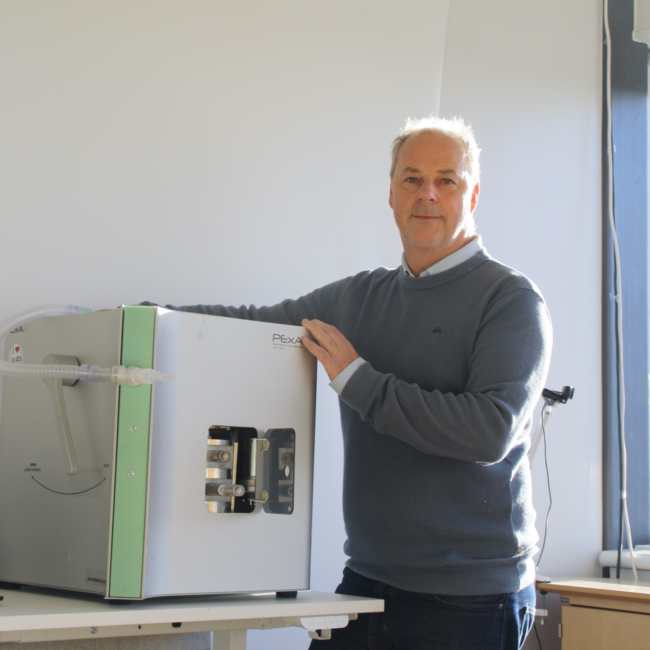
Lung diseases such as COPD, asthma and lung cancer are particularly challenging because many of them begin in the deepest part of the lung, the small airways, where sampling has been difficult. Historically, knowledge of what occurs in these deeper lung regions has been limited, as it has been risky and uncomfortable for patients to obtain samples from this area. Methods used today, such as bronchoalveolar lavage (BAL) or lung biopsies, are highly invasive. This is where PExA offers a breakthrough, enabling non-invasive sampling from the small airways for the first time.
Breaking new ground for biomarker discovery
PExA’s technology allows for the collection of focused biological samples that originates from the small airways without the need for invasive procedures.
Instead of inserting tubes or needles, the PExA instrument collects samples as the patient breathes in a controlled manner, generating particles from the small airways. These "PEx samples", provide a highly focused look at the area of the lungs where many diseases start and progress, often undetected until they reach a stage that is difficult to treat.
This ability to sample from the small airways is game-changing and the PExA instrument opens up new possibilities to explore this important region and discover novel biomarkers for lung diseases. For the first time, the non-invasive approach, also enables repeated sampling in order to track biological changes over time. This non-invasive approach is not only safer but also allows for greater insight into local and individual disease progression.
Cheaper and more sensitive biochemical analysis increase the potential
PExA is today used globally by a wide range of research groups, from academia to pharmaceutical companies, and across various sectors, including public health authorities.
“Our instrument is unique in that it allows to identify biomarkers or specific proteomic patterns that are linked to lung disease. It is also possible to track how different omics-patterns develop over time or how they respond to different treatments. In recent years, biochemical analysis methods have advanced from being able to detect just a few proteins to identifying over 1 000 proteins in PEx samples at a tenth of the previous cost. This greatly improves the chances of finding biomarkers,” explained PExA CEO Tomas Gustafsson.
Increased interest in using the PExA instrument
The increased interest in PExA’s instrument reflects its potential impact across a wide range of applications. The company has already customers in Europe, US, South Africa, and Australia, and has begun to actively participate in some of the world’s largest lung congresses.
“Due to our increased presence at the major lung congresses supported by more than 50 scientific articles we’ve seen a significant rise in interest from research groups worldwide.
The focus is to reach out to a larger customer base that we have never addressed before. We want to establish the instrument globally on a large and broad research market, covering everything from work environment-related lung damage to serious medical conditions such as COPD and lung cancer. The broader the application of our instrument, the greater the likelihood of discovering biomarkers for one or more diseases”, said Tomas Gustafsson.
Looking ahead to diagnostics
While PExA is currently focused on selling its research instrument, the long-term goal is to develop diagnostic instruments that can quickly provide relevant biomarker data. This transition from research to diagnostics represents a major step forward for the company.
“It is particularly exiting that The Swedish Cancer Society has funded professor Sandra Lindstedt at Lund University, in her study of using PExA to find biomarkers to be able to diagnose and follow up lung cancer patients”, says Gustafsson hopefully.
In addition to lung cancer, the PExA method is currently being used in comparative studies that analyze differences in protein-, lipid- and miRNA-profiles between healthy individuals and patients with diseases such as asthma, COPD, Covid and occupational lung damage.
By comparing protein data from hundreds of proteins, researchers can now detect patterns that could eventually be used to identify specific biomarkers for these diseases. The ultimate goal is to move towards developing diagnostic applications based on these findings.
The development of a diagnostic instrument built on PExA’s technology could transform how lung diseases are diagnosed, allowing for earlier and more accurate detection, and opening up new possibilities for patient care.